Showing posts with label Assam Plains. Show all posts

Friday, 12 June 2020

Manas NP, Assam: A Trip Report from a visit in December 2019

Author: Ravi Kailas (ficustours@gmail.com)

Dates: 11th to 15th December 2019


One-horned Rhinoceros are among Manas's fantastic mammal diversity


What was meant to be a very brief visit to Manas last December, turned out longer, thanks to the intricacies of India's vibrant democracy and politics. I could have, after 2 nights here, travelled as planned though, to Kakoijana Reserve Forest, then onward to Kaziranga NP and Hollongapar Gibbon Sanctuary - however, such a move would have probably resulted in me being hit by rock targeting my nut (or something equally unpleasant). There was also a faint possibility of me escaping unscathed, but I decided to play the percentages and brave the alternative of staying back close to a friendly village in a quiet corner of Assam with three square meals of fresh, Assamese grub, unlimited tea and with an alluring, biodiverse national park, largely bereft of other tourists to boot, at my door-step. The fact that Manas hosts some of India's rarest mammals (including species like Mainland Clouded Leopard, Binturong, Pygmy Hog and Hispid Hare), with at least a vague chance of seeing them, and a reputation for fantastic birdlife (including as one of the best places to see Bengal Florican in its breeding season, and a whole host of birdlife where the Brahmaputra's floodplains meet the Eastern Himalayas), made the decision to stay put a no-brainer. And there were tantalising prospects like staying the famed, superbly located, Mathanguri FRH, which at other times, would be booked out well in advance and visits to Bhutan, via the contiguous Royal Manas National Park ....   

Manas landscape

Lowland forest in Manas

This trip, however, was not just any other wildlife travel experience, with the rather more relaxed pace of it (albeit, forced upon by the circumstances), allowed me to look a little bit under the hood of the park - once a UNESCO World Heritage Site for its wildlife riches, then devastated by insurgency and its side-effects on its wildlife, bouncing back of late, but still a pale shadow of its (reputedly) former self. Samson (my naturalist guide), reminisced about the superb quality of the grasslands in the past, now slowly taken over by woodland and weedy species. He spoke about of the disturbance caused by ever increasing vehicular movement moving into Bhutan through Manas (an 24hr affair), and correlating this to how many species that were relatively easy to see earlier (Leopard Cat! among them), were hardly seen these days. About how the population of Indian Peafowl had increased tremendously (the ecological causes and implications?) and to a lesser extent, of leopards (on the face of it, a desirable situation, but could there be a more sinister ecological cause for this?). On the bright side, Samson spoke about lasting peace in the region after decades of insurgency, villages here, even during the troubled times when I visited, calm and peaceful, insulated from the political strife that had brought the rest of Assam to a standstill...... 

The Wildlife ..... 

The rather attractive Silver-breasted Broadbill showed up in beautiful light one morning


As it turned out, the birdlife was impressive and engrossing, especially for sheer numbers and diversity, reflective of the variety of habitats that Manas encompasses, with species like Silver-breasted Broadbill, Collared Falconet, Rufous-bellied Eagle, Chestnut-capped Babbler, Blue-bearded Bee-eater, Speckled Piculet, Black-backed and Slaty-backed Forktails, Rufous-necked Laughingthrush, Pin-striped Tit Babbler, Small Niltava and Pin-tailed Green Pigeon among the highlights. The richness of this birdlife was especially evident on a full day outing to Mathanguri FRH from the Bansbari entrance gate, with 88 species (including most of the aforementioned highlights, some in noisy, abundant, mixed flocks of Phylloscopus warblers, woodpeckers, nuthatches, drongos, fantails and minivets) making it to the list, as we patiently scoured the various game roads, exploring the lowland forests and grasslands, on a crisply cool, clear day. Another feature of the birdlife on this visit was the sheer abundance of Green Pigeons (especially of Yellow-footed, but also Pin-tailed), most seen feeding on copiously fruiting Bischofia javanica (these fruits also attracted barbets, bulbuls and parakeets in good numbers). The road to Bhutan from Mathanguri, through a distinctly different (to the typical floodplains habitat on the Indian side) hill forest, promised much for birdlife, but turned out surprisingly quiet on that front (admittedly though, the birding effort was somewhat limited by pressures of time). However, efforts on this route did prove productive for the lovely Sultan Tit, Slaty-backed Forktail and Crimson and Black-throated Sunbirds, that I had not seen in the Indian side of Manas. There was decent birdlife as well, on the fringes of the park, walking around the predominantly tea plantation dominated countryside, with patches of woodland and settlements to break the monotony, and also along the fence demarcating the park boundary, producing species like Yellow-vented Warbler, Little Pied Flycatcher and Common Quail, among commoner birds, between frequent stops for black tea and snacks. Nights in the vicinity of my lodge, often in efforts to find a bar of mobile connectivity (the other bars were shut given the political situation)  to enquire about happenings in the outside world (necessary to plot my escape back home via this potential death trap - or so the television media had me believe) produced Brown Hawk Owl and Asian Barred Owlet

Pin-striped Green Pigeon

The fruits of the Bischofia javanica were very popular among Green Pigeons

Pin-striped Tit Babbler

Chestnut-capped Babbler

 
While Manas's rarer mammals were always going to be, well, rare, I was treated to good sightings of One-horned Rhinoceros (reintroduced here about 15 years back, after the local population was decimated by poaching), Asian Elephant, Assamese Macaque, Capped Langur and a host of other smaller mammals. Among them were numerous sightings of three diurnal squirrels, namely, Black Giant, Hoary-Bellied and the diminutive Himalayan Striped. The only sighting of Assamese Macaque was on the forest road leading from Mathanguri to Bhutan (pic below). The presence of Assamese Macaque surprised Samson (my guide), who had, until now, identified them as the similar looking Rhesus Macaque. For large mammals, the clearing overlooked by the Bura Buri (?) watch-tower was a productive site, where elephant, rhino and gaur are attracted to the salt put out by the forest staff (a less than desirable practise for attracting wildlife, discontinued in more evolved parks). Among the (realistic) target species of mine was to see Crab-eating Mongoose, which are known from this landscape, but dedicated efforts looking around jungle streams and ponds, was productive only for single sighting of the more widespread Small Indian Mongoose. Another creature that my guide was keen to show me was a Black Panther, which are reputedly seen, somewhat regularly, in Manas. As it turned out, no luck on that front, nor for the more common variant of the Leopard (except pug marks on the road leading to Bhutan from Mathanguri). There was no sign of Gee's Golden Langur either, which were once regular just across the river (in Bhutan) from Mathanguri, but now, reputedly, very irregular in these parts. As per my guide, night forays along the park boundary adjacent to the Bansbari Gate, can sometimes be productive for Hispid Hare, but given the troubled times, I was advised not to venture out in the dark, so I cannot confirm either way. Mainland Clouded Leopard are seen once or twice a year in Manas, so perhaps not a realistic target species here, especially given the restrictions for tourists to move around in the dark. However, on my evening visit to Bhutan, on the 13km drive (one way) from Mathanguri to Panbang and back, on a road which is open for traffic through the night (technically though, I understood, only for Bhutanese nationals going back and forth), extended into the dark - giving me an opportunity to look for mammals (and what mouth-watering possibilities in these parts!, but I had no luck whatsoever on this effort) in the dark in a very promising stretch of hill forest. There was nobody on either the Bhutanese or Indian sides to monitor the road either, but this could just be an aberration (given the exceptional circumstances) and you might get an untimely tap on your shoulder, just as you focus on a cat like animal skulking in the undergrowth, when you try. One does need to stay at the Mathanguri FRH though, for this potential activity, and the probability of confirmed bookings here, on the dates of your choice, may just be about be as likely as coming across the mammals you are keenly seeking out in these parts!

The sole sighting of Assamese Macaque on the Panbang-Mathanguri Road


Capped Langur were the commonest primates in Manas

Among the several herds of elephants on this visit

Himalayan-striped Squirrel


Logistics etc. 


The arrangements for the accommodation in Manas and the taxi that ferried me from Guwahati was through the excellent Ankur Burman, who operates a regionally focussed travel outfit, freelances as a guide, owns a restaurant serving Assamese cuisine (Green Chilly Restaurant near Abhyapuri, an hour or so from Manas) and works for a wildlife conservation organisation called Aranyak. Do get in touch with him for your local travel needs (including for safaris in Manas NP and the rest of Assam), taxi bookings, cycling expeditions, camping experiences and other locally oriented experiential travel  - +91 97063 42001/+91 60013 04125. I was especially impressed with the extra care and concern from his end, to keep me safe, updated on local conditions as they evolved and his assistance to get me back home, in those times of strife and uncertainty in Assam. 

The affable Gopen Indigo (+91 97069 61022), the driver (and owner) of the Swift Dzire (my taxi), had some inside scoop on the best samosas and jaal mudi at the village near Bansbari Gate and was generally patient and obliging with my (potentially) inexplicable fascination with monkeys, birds and mammal poo. 

Accommodation


I stayed at the Birina Lodge, about a km from the Bansbari Gate. The budget accommodation is pleasantly located amidst tea plantations, in a rural landscape, with simple and rustic rooms, comfortably furnished (they offer both independent cottages and spacious rooms in the main building, with en-suite facilities). The food was simple, delicious, local style cuisine with rotis, rice, dal and freshly sourced veggies (the brinjal was insanely soft!) as the mainstay. A special thanks to Mr Kishak Pathak, the manager at the lodge, and all his staff for the friendly hospitality and making me feel very safe, when I was almost the only tourist in general vicinity. Mr. Kishak was also suitably well connected with the forest department and helped arrange my accommodation at Mathanguri FRH, all the safari logistics, including my naturalist guide, Samson (who turned out to be a very good birder and suitably well informed about the nuances of Manas as will be useful to nature enthusiasts. Do get in touch with him for your guiding needs here +91 7986942708). 

Mathanguri and across to Bhutan


Readers who have braved the piece thus far, would have likely guessed, a. that I managed a brief stay at the Mathanguri FRH, and, b. that I entered Bhutan from there. 

The view, overlooking the Manas River from the Mathanguri FRH

Mathanguri Forest Resthouse is a forest department managed set-up about 20km from the Bansbari Gate, on the Bhutan border.  The unfenced building is spectacularly located on the high banks of the Manas River, overlooking the river and the forested hills of the Royal Manas National Park in Bhutan (a contiguous protected area with India's Manas NP). My overnight stay here was one of those totally unplanned, serendipitous events, facilitated, ironically, by my being 'forced' to stay back in Manas, while other visitors, some of whom had managed to book rooms here at this time, had to cancel their plans for the same reasons. 

The view of the Manas River, a scenic accompaniment on the Mathanguri-Panbang road

Among the numerous hill streams on the Mathanguri-Panbang road

The entrance to the Royal Manas NP along the road to Panbang 

Panbang, the closest town in Bhutan, is about 13Km from Mathanguri, on a dirt road through a lovely, fern-adorned hill forest, crisscrossing numerous, crystal clear streams with the shingle-filled Manas River a constant companion on one side of the road. However, one enters Bhutan (and the Royal Manas NP), within a km from Mathanguri and the road is bereft of any other settlement until reaching a check-post at Panbang. 

Indian Nationals are allowed into this charming little town, for a small fee (and upon producing a Passport or Voter ID ... I managed with an Aadhar though), during the day - so close to India, yet quite distinct in appearance, language and religion - but can only access a small portion of it. While the town is connected to the rest of Bhutan by road, visitors are not allowed to enter further into the country through this border (and my feeble attempts to make good a grandiose plan to get back home via Bhutan, to avoid the strife torn route via Assam, was effectively thwarted by a friendly, but firm lady, in-charge of the entrance tickets at the check-post). The town has a smattering of restaurants (better stocked with Druk beer and green tea than vegetarian food), lodging (where visitors entering through this border cannot stay overnight in any-case) and shops. While visiting there in the morning, I tried an interesting breakfast fare of rice with a creamy potato dish, rich in turmeric, and Dal, distinctly seasoned with star anise, served with a side of green chilly, onion and Kaaza Nimbu (a very aromatic, elongated lemon from Assam). The food was definitely familiar but there was something charmingly foreign about it as well. It might help to know that Indian Rupees is accepted in Panbang (and I understand in the rest of Bhutan), but you will likely get your change in the local currency. 


Breakfast (!) at Panbang


List of Mammals Seen


Asiatic Elephant Elephas maximus
Asiatic Water Buffalo Bubalus arnee
Greater One-horned Rhinoceros Rhinoceros unicornis
Gaur Bos gaurus
Indian Munjtac Muntiacus muntjak
Sambar Cervus unicolor
Wild Pig Sus scrofa
Himalayan Striped Squirrel Tamiops mcclellandii
Black Giant Squirrel Ratufa bicolor
Hoary-bellied Squirrel Callosciurus pygerythrus
Capped Langur Trachypithecus pileatus
Assamese Macaque Macaca assamensis
Rhesus Macaque Macaca mulatta
Small Indian Mongoose Herpestes auropunctatus


List of Birds Seen 


Eurasian Moorhen
Ruddy-breasted Crake
Great Egret
Small Minivet
Citrine Wagtail
Brown Shrike
Yellow-vented Warbler
Indian White-eye
Common Merganser
Red Junglefowl
Kalij Pheasant
Pin-tailed Green-Pigeon
Green-billed Malkoha
Common Hawk-Cuckoo
Indian Thick-knee
Black-necked Stork
Osprey
Rufous-bellied Eagle
Asian Barred Owlet
Blue-bearded Bee-eater
Chestnut-headed Bee-eater
Indian Roller
Speckled Piculet
Gray-capped Woodpecker
Greater Flameback
Lesser Yellownape
Streak-throated Woodpecker
Greater Yellownape
Collared Falconet
Silver-breasted Broadbill
Long-tailed Minivet
Short-billed Minivet
Scarlet Minivet
Black-winged Cuckooshrike
Black-hooded Oriole
Ashy Woodswallow
Common Iora
White-throated Fantail
Lesser Racket-tailed Drongo
Hair-crested Drongo
Greater Racket-tailed Drongo
Common Green-Magpie
Rufous Treepie
Yellow-bellied Fairy-Fantail
Gray-headed Canary-Flycatcher
Sultan Tit
Cinereous Tit
White-throated Bulbul
Blyth's Leaf Warbler
Chestnut-capped Babbler
Pin-striped Tit-Babbler
Velvet-fronted Nuthatch
Asian Brown Flycatcher
Oriental Magpie-Robin
Pale Blue Flycatcher
Small Niltava
Black-backed Forktail
Slaty-backed Forktail
Little Pied Flycatcher
Plumbeous Redstart
White-capped Redstart
Ruby-cheeked Sunbird
Crimson Sunbird
Black-throated Sunbird
Streaked Spiderhunter
Asian Fairy-bluebird
Indian Peafowl
Oriental Turtle-Dove
Spotted Dove
Yellow-footed Green-Pigeon
Green Imperial-Pigeon
White-breasted Waterhen
Red-wattled Lapwing
Green Sandpiper
Asian Openbill
Lesser Adjutant
Great Cormorant 
Little Cormorant
Spot-billed Pelican
Little Egret
Cattle Egret
Indian Pond-Heron
Crested Serpent-Eagle
Changeable Hawk-Eagle
Common Kingfisher
Stork-billed Kingfisher
White-throated Kingfisher
Green Bee-eater
Lineated Barbet
Blue-throated Barbet
Eurasian Wryneck
Fulvous-breasted Woodpecker
Gray-headed Woodpecker
Red-breasted Parakeet
Large Cuckooshrike
Black Drongo
Bronzed Drongo
Long-tailed Shrike
Gray-backed Shrike
Black-crested Bulbul
Red-vented Bulbul
Red-whiskered Bulbul
Dusky Warbler
Striated Babbler
Jungle Babbler
Rufous-necked Laughingthrush
Asian Pied Starling
Chestnut-tailed Starling
Common Myna
Jungle Myna
Great Myna
Taiga Flycatcher
Siberian Stonechat
White Wagtail


Thursday, 26 March 2020

Stump-tailed Macaque, Golden Langur and other wildlife of Assam, Feb 2020: Trip Report


Author & Naturalist: Ravi Kailas (ficustours@gmail.com)

A report based on a mammal-watching oriented guided trip (with a focus on Primates) to the lowland forests and floodplains of the Bramhaputra in Assam, northeast India. Mammal Highlights included superb species like Gee's Golden Langur, Stump-tailed Macaque and Western Hoolock Gibbon among six species of primates, One-Horned Rhinoceros (aplenty) among large congregations of herbivores at Kaziranga, Smooth-coated Otter and Ganges River Dolphin. Other highlights included Pallas's Fish Eagle, Great Pied Hornbill, Assam Roofed Turtle?, Brahminy Worm Snake and the lovely, albeit sometimes incorrigibly leech infested, lowland forests of the Gibbon Wildlife Sanctuary. Mark's in-depth knowledge about the primates of the region (and the world!), and excellent local guides everywhere, enriched this productive trip even further.

The distinctively stocky Stump-tailed Macaque - one of the highlights from the trip

Dates


22nd to 27th Feb 2020

Locations


Kakaoijana Reserve Forest; Kaziranga NP and Gibbon Wildlife Sanctuary

Tour Participants


Mark Spence, a keen primate enthusiast who has travelled extensively in search of the some of the Earth's most elusive simians and their 'lesser' cousins, especially through the steamy jungles of south-east Asia.  This was an extension of his with us in India, immediately following a brief visit, to the Western Ghats of south India, which produced 5 primates among 21 species on mammals. Please read a report from this leg here.

Detailed Report


Day 1, Kakoijana Reserve Forest


Having arrived in Guwahati the previous evening, after a full day of air travel (and airports) from the distant southwest corner of the country, a relaxed start to the morning for the 3 hr or so drive to Ashtha Nature's Home at Abhyapuri - our host in the vicinity of Kakoijana. The drive through a rural landscape peppered with forested hills - including monocultures of Sal - was peaceful but not especially productive for wildlife. However, on the cusp of entering Abhyapuri, crossing an inevitably long bridge across the Brahmaputra, a few moments looking into the centre of the river produced the enigmatic and endangered Ganges River Dolphin. We counted four individuals in a small section of the river, occasionally surfacing for breath, showing up momentarily over the river's grey waters, before diving back into darkness. In our brief time looking, one showed up especially nicely, with its snout fully exposed - the most satisfying view possible of these river dolphins, which are largely hidden under murky waters.

Golden Langur were relaxed in a village adjacent to the Kakoijana Reserve Forest

We checked-in at our hotel around noon and upon the advice our local guide, we head straight to Kakoijana Reserve Forest, for any remaining Golden Langur activity before they rested in the heat of the afternoon. Just a few minutes into a trail along the forest, we came across a troop of these endangered, attractive monkeys, feeding in a patch of forest that is probably the most reliable location, globally, to see this range-restricted species. The 500 or so Golden Langur known from this highly modified reserve forest, are a remnant from what was originally a contiguous range along riparian forest in Western Assam leading into hills of Bhutan. While normally idyllic, our local guide assured us, tunes blared out from the adjacent village in celebration of Mahashivarathri (a religious festival celebrated through India), as we watched the langur nonchalantly going about their feeding and grooming routine, regardless.

The lair of the Golden Langur as seen from adjacent fields

A flycatcher from among the modest forest birding we managed at Kakoijana

A brief break for lunch followed, in the typical resting time for the monkeys, and we returned around 330 PM on what turned out to be a cloudy evening, to find the same troop of langur, but now inside a village, adjacent to the forest. We watched them for an hour or so until they disappeared into hidden tree-tops to roost for the night. Walking along the forest trails around dusk, on a faintly drizzly evening, produced our first 'forest' birding experience on the trip and we saw Dark-sided?, Grey-headed Canary and Verditer Flycatchers, Spangled Drongo, Fulvous-breasted Woodpecker and Blue-throated Barbet among common countryside birds. The forest itself was largely teak dominated (planted) with patches of natural vegetation along forest streams. We focussed our efforts along these streams in the hope of seeing Crab-eating Mongoose, but although we saw crabs (and prawns, tadpoles, fish) in the streams, we had no luck with the mammal. Later, in the dark, our first snake of the trip, a fast wiggling, worm-like, Brahminy Blind Snake as it crossed the forest trail, and a handful of frogs in the forest streams. Some bat activity along a copiously flowering tree, a lone Common Palm Civet and an orange eye-shine at Sambar eye-level capped the late evening mammal list from a forest where we had little prior expectation of nocturnal mammal potential.

Day 2, Kakoijana and drive to Kaziranga


We were at Kakoijana by 0630 for another date with Golden Langur and upon a brief search in the cool of the morning, found the a troop as they became active with the rising heat of the morning sun, well within the village. Earlier, a little walk along the forest trail produced some distant, hidden macaques which we identified as Rhesus (could it have been Assamese?). Birds added colour to the scene, as we watched the langur, and included Blue-throated Barbet, Asian Fairy Bluebird, Grey-winged Blackbird, Greater Flameback, Chestnut-tailed Starling and Black-hooded Oriole. The impending long drive to Kaziranga, capped our morning effort at 0830, but that was plenty of time to enjoy the antics of our star simian here, one final time.

Up close and personal with Golden Langur, in the village adjacent to Kakoijana

The eight hour plus drive to Kaziranga was interesting for a variety of birds, especially in the swampy habitat beyond Guwahati and produced innumerable Lesser Adjutant Stork, Asian Openbill and Black-shouldered Kite and Pied Harrier. There was a profusion of flowering Silk Cotton trees in this rural landscape, continuing into Kaziranga. Reached the fringes of Kaziranga around 1630, and the abundance of wildlife it hosts was immediately obvious with herds of Asiatic Wild Buffalo, Hog and Swamp Deer, One-Horned Rhinoceros, Capped Langur, Bar-headed Goose and Wooly-necked and Lesser Adjutant Storks seen on the way to Wild Grass Resort, our host for the night.

Lesser Adjutant Stork

Day 3, Kaziranga


0600 start on a cold morning towards the Bura Pahar Range, on the western fringes of Kaziranga. The hour and half drive to the range entrance produced Capped Langur, Rhesus Macaque, Hog Deer, Wild Pig, One-Horned Rhinoceros, Hog, Barking and Swamp Deers, Asiatic Wild Buffalo and Hoary-bellied Himalayan and Malayan Giant Squirrels, but no Hoolock Gibbon, which are sometimes seen along this busy main road. Birdlife was typically excellent, and included a pair of Great Pied Hornbill, Lineated, Coppersmith and Blue-throated Barbets gorging on a fruiting ficus, Grey-chinned and Scarlet Minivets, Bar-headed Goose, Greater Racket-tailed Drongo, Crested Serpent Eagle and Asian Barred Owlet among others.

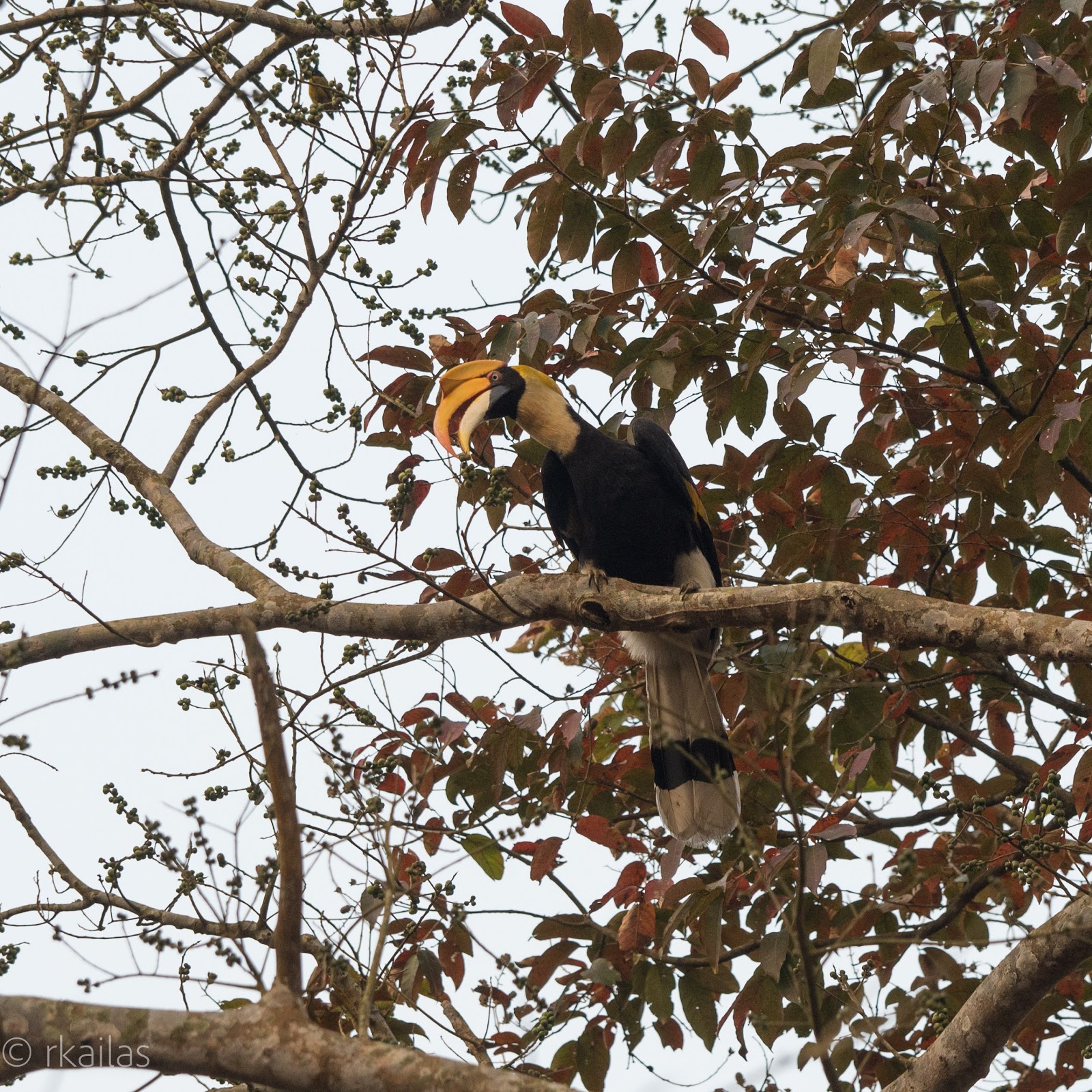
Great Pied Hornbill on a fruiting fig tree
Hog Deer
Black Giant Squirrel


Entered the safari road inside the park at 0745, while it was quite sunny, but still with a nip in the air. The initially forested road, via a swamp, towards the Bramhaputra, produced more Capped Langur, several Hog Deer, and a lovely family of Smooth-coated Otter, clambering up the banks of the river to sun bathe. The route then followed the typical elephant grass dominated habitat of Kaziranga and we saw a handful of One-Horned Rhinoceros - uncharacteristically (for Kaziranga) wary of safari vehicles, in this little visited part of the park - Hog and Swamp Deers, Wild Pig, Rhesus Macaque and the pervasive calls of gibbon from the forested hills. Birdlife was typically excellent and included Pallas's Fish Eagle (feeding on what looked like an Asian Openbill kill), Grey-headed Fish Eagle, Crested Goshawk, Short-toed Snake Eagle, Crested Serpent Eagle, various ducks, Striated Grassbird and Golden-fronted Leafbird among others. Exited the zone around 1130, when it was bright, sunny and warm.

A somewhat wary One-Horned Rhinoceros in the little visited Bura Pahar Range
Smooth-coated Otter on the banks of the Bramhaputra


A quick turnaround to enter the popular Central Zone of the park at 1400 (when the gate opens for the evening safaris). Many more vehicles than at Bura Pahar. This zone is a mix of grassland, swamps and woodland with notably high numbers of (very relaxed) rhinos. We also saw Smooth-coated Otter, Asiatic Wild Buffalo, the sole Asiatic Elephant from here, virtually hidden in the tall grass, Hog and Swamp Deers and Hoary-bellied Himalayan Squirrel among the mammals. Memorably we saw about 40 or so turtles (Assam Roofed Turtle?), basking in the warm afternoon sun, on fallen logs along a water channel. Birdlife was once again abundant, and included Pallas's Fish Eagle (including in a nest with two chicks), Slender-billed Vulture, Cinereous Vulture, Crested Serpent Eagle, Spot-billed Pelican, Green-billed Malkoha, Rose-breasted Parakeet, various ducks and waders and numerous Asian Openbill and Lesser Adjutant Storks. Exited by 5 PM, a strictly enforced closing time for safaris in the park.

Pallas's Fish Eagle nest with chicks

Slender-billed Vulture


Day 4, Gibbon Wildlife Sanctuary

One of the trails at the lovely, lowland forest of Gibbon Wildlife Sanctuary

0400 from our resort in Kaziranga for a 2.5 hour drive to Gibbon Wildlife Sanctuary. Post formalities/a cup of black tea from a local vendor set out on a trail looking for the primate riches of this lovely, albeit tiny, island-like sanctuary of lowland forest (dominated by the tall Hollong tree, rich in epiphytes, ferns and lianas but surrounded on all sides by tea plantations/rural landscape with a rail-track running through). Our local guide, Jivan Bora and accompanying forest guard, Sharma, did not take long to locate a delightful family of Western Hoolock Gibbon, just stirring to life in the cool of the morning. We watched this family of an adult pair with a sub-adult and a baby offspring, deftly avoiding missiles from above, as they took care of their first order of business of the morning from high in the canopy, before swinging, all arms and legs, between trees feeding on forest fruit and resting in-between. After an eye (and camera) full of these acrobatic animals, including of an amusing interaction between the baby gibbon and a Black Giant Squirrel, we spent sometime with a family of Capped Langur in the vicinity. A short break for our (delicious) breakfast of Puri and Guguni at a mobile restaurant at the entrance of the park and it was time to look for the bear-like Stump-tailed Macaque - one of our main targets in the sanctuary. This sanctuary is known to host three very large troops of 60+, 180+ and 260+ individuals, but their daytime nomadic, foraging habits in dense forest undergrowth makes them one of the more difficult macaques to track - as we found out in the next hour or so looking, stumbling through thick undergrowth, looking for uprooted plants on which they feed (key evidence of their presence), but with no luck. On our way back to the park entrance, along the railway track that cuts through the park, we came across a troop of Capped Langur active on the forest edge along the track. While the forest was filled with bird calls (including of Red-headed Trogon and Asian Barred Owlet) in the morning, the high canopy and dense undergrowth ensured that we saw few, including Greater Yellownape Woodpecker, Ashy Drongo, flock of Scarlet Minivet, Blue-winged leafbird and a flycatcher sp. Exited the park around 1015 to sit out the warmth of the late morning at the Gibbon Homestay - where we were greeted by Diganta Gogoi, a cool glass of home-brewed rice wine and a large Indian Rat Snake foraging in the farmland adjacent to the homestay - our host for the next two nights.
Western Hoolock Gibbon (male)

Capped Langur

Indian Rat Snake

Re-entered the park around 1400, in a concerted effort to find Stump-tailed Macaque, stumbling deeper off-trail into the forest, initially scouring the forest where a troop was spotted recently, and later in the evening, in known roosting trees of this troop. Nothing to show for the effort though, except a leech bite, a sting from a nettle, Leopard Cat scat and a handful of birds such as Greater Flameback, Lineated Barbet and Yellow-footed Green Pigeon (generally subdued in this department as well). Sadly, we also came across a Capped Langur, lying battered on the railway track - a significant threat to wildlife both as a source of mortality as well as a hard boundary fragmenting an already modestly sized forest -  possibly an individual from the troop we saw in the morning.

Typical leftovers from foraging Stump-tailed Macaque - key evidence to their presence

Day 5, Gibbon Wildlife Sanctuary

An elephant occupying the trail ahead at Gibbon WLS
Western Hoolock Gibbon (female)

Overnight rain ensured a damp, cool forest when we entered the park at 0700, still focussed on finding the elusive Stump-tailed Macaque. Almost as soon as we entered, a large, evidently aged Asiatic Elephant occupied the trail ahead of us, pausing our advance for a few minutes, before we ventured deep into the forest and through thick bamboo on a leech infested, mucky trail. After about 2 hours looking, unsuccessfully, stumbling onto the main trail with innumerable leeches accompanying their breakfast host (on yours truly especially, sans leech socks), we found the same family of gibbon from the previous morning, just as news arrived that the macaques had been heard in another part of the forest. Rushed to the site via the entrance, past a distraction of Rhesus Macaque, speeding on motorbikes along the slippery, main forest road, for a couple of kilometres. Bikes parked, stumbling off trail through dense primary forest, onto evidence of Stump-tailed Macaque (very recently uprooted plants), soon led us bang in the centre of a huge troop of these bulky primates. We followed them as they moved (and countless appearing seemingly from nowhere), incessantly, (mostly) along the forest floor, initially very shy, but later bolder. Very vocal, and much interactions between individuals like typical macaques, but such different habitat use and such a distinctive appearance with so much character! After a very satisfying hour or so with the macaques, notwithstanding the less than ideal environment for humans to venture in pursuit of rare monkeys or otherwise, we found our way to the forest road, unsurprisingly, not before losing it in the featureless interiors of this dense forest. On the other side was a troop of Pig-tailed Macaque, much more obliging in the low canopy of the forest edge and our 5th primate from the sanctuary. Exited the sanctuary around 1130, to culminate a very satisfactory morning and onto a well earned breakfast cum deleeching/otherwise self-grooming experience at our lodge.

One of those rare occasions when a Stump-tailed Macaque showed itself out in the open
A typical view of these macaques through the dense undergrowth of primary forest
.....................

With all realistic target species from here already (satisfactorily) recorded, we entered the park at 1530 for a two hour or so leech free amble along the main forest road, on a cloudy evening. A troop of Rhesus Macaque at the entrance followed by a trio of very skittish Orange-bellied Squirrel traversing the trunks and branches of tall rainforest trees and more Capped Langur were among the mammals this evening. The puddles of water on the road attracted flycatcher-like birds for a dip, but id was confounded by poor light and the rather brief visits by the birds before they disappeared into the undergrowth. There were, however, some easier (and commoner birds) on the canopy - Ashy, Spangled and Greater Racket-tailed Drongos and Red-breasted Parakeet to name a few - that obliged with better views on our last effort on this productive trip.

List of Mammals Seen


Golden Langur Trachypithecus geei
Capped Langur Trachypithecus pileatus
Stump-tailed Macaque Macaca arctoides
Northern Pig-tailed Macaque Macaca leonina
Rhesus Macaque Macaca mulatta
Western Hoolock Gibbon Hoolock hoolock
Common Palm Civet Paradoxurus hermaphroditus
Hoary-bellied Squirrel Callosciurus pygerythrus
Orange-bellied Squirrel Dremomys lokriah
Black Giant Squirrel Ratufa bicolor
Asiatic Elephant Elephas maximus
Greater One-horned Rhinoceros Rhinoceros unicornis
Asiatic Water Buffalo Bubalus arnee
Swamp Deer Rucervus duvaucelii
Hog Deer Axis porcinus
Indian Munjtac Muntiacus muntjak
Ganges River Dolphin Platanista gangetica
Smooth-coated Otter Lutrogale perspicillata
Indian Flying Fox Pteropus giganteus
Indian Wild Pig Sus scrofa

Nomenclature as per Menon, V., 2014. A Field Guide to Indian Mammals. Hachette India. ISBN 978-93-5009-760-1

Logistics Etc


Kakoijana 


We stayed at the rather simple, but adequate accommodation at Astha Nature's Home (Abhyapuri), located about 15 kms from forest patch Kakoijana. Food was simple, local style and tasty.

Our host for this brief leg of the tour was the excellent Ankur Burman, who operates a regionally focussed travel outfit, freelances as a guide, owns a restaurant serving Assamese cuisine (Green Chilly Restaurant, where we had a hearty lunch) and works for a wildlife conservation organisation called Aranyak. Do get in touch with him for your local travel needs (including for safaris in Manas NP and the rest of Assam), taxi bookings, cycling expeditions, camping experiences and other locally oriented experiential travel  - +91 97063 42001/+91 60013 04125.

Kaziranga


We stayed at Wild Grass, the pioneer of eco-tourism in Kaziranga, located close to the Central Zone of the park. The accommodation, is rustic, clean and comfortable and meals are simple, local style and tasty. Mr Manju Baruah, one of the owners, has a wealth of knowledge about the park and its wildlife. Wild Grass also arranges safaris and in and around Kaziranga. Do get in touch via email: wildgrasskaziranga@gmail.com or call their manager Dilip Gogoi: +91 87618 33837 for more information.

Although, we tried and did not succeed, Parti-coloured Flying Squirrel are known to visit the rural landscape around Wild Grass.

Gibbon Wildlife Sanctuary


We stayed at the Gibbon Homestay, about 10 Kms from the Gibbon Sanctuary, offering clean, comfortable, modern rooms and hearty, local style meals. The host, Diganta Gogoi (+91 99544 03770), a guide himself (though we used another person this time), arranges all the logistics here.

We were guided by the superb Jivan Bora, but for whose excellent tracking skills and dedication, the Stump-tailed Macaque would have remained elusive. Do get in touch with him for your guiding needs at Gibbon Wildlife Sanctuary: +91 99570 83689.

www.ficustours.in
ficustours1 (Instagram)


Monday, 18 November 2019

Report: Birds and wildlife of Maguri Beel, Dihing Patkai and Namdapha, March 2019

Author: Ravi Kailas (ficustours@gmail.com)

A birding tour to the famed wetland/Terai grassland of Maguri Beel (Dibru-Saikhowa NP), Dihing Patkai WS (among the last remaining lowland evergreen forest in NE India) and the biodiverse, but troubled Namdapha NP in the foothills of Eastern Himalayas revealed some fantastic species including, Red-headed Trogon, White-crowned Forktail, Sapphire Flycatcher, Pale Blue Flycatcher, White-browed Piculet, Chestnut-backed Laughingthrush, Collared Treepie, White-winged Wood Duck, Brown-cheeked Rail, Rufous-necked Hornbill, Sultan Tit, Yellow-bellied Warbler, Grey-throated Babbler, Barred Cuckoo Dove, Bay Woodpecker, Long-tailed Broadbill and a handful of mammals, including Asiatic Elephant, Himalayan Marten and various forest squirrels. Each location provided a unique experience - the sheer abundance of waterfowl in Maguri Beel (minus rarities like Eastern Spot-billed Duck and Baikal Teal, which are known from here), the rich, humid rainforest of Dihing-Patkai - filled with bird calls, epiphytes and butterflies and the the mesmerising scenery, fantastic forest birdlife and tantalising possibilities of Namdapha, albeit in an all too brief visit here. It was already rainy season by early March in this part of the world and rain (and leeches) followed us in spurts almost every day. Accommodations ranged from charming to poor to scenic respectively, but the food, especially for a vegetarian like me, was a (pleasant) revelation, with unique local variations to the dals and subjis, the aromatic varieties of local rice, fresh ingredients and delicious chutneys.

The lovely (not so) Red-headed Trogon, among the considerable bird riches in the lowland forests of Dihing-Patkai Wildlife Sanctuary

Dates: 


3rd to 10th March 2019

Locations: 


Maguri Beel (Dibru-Saikhowa NP) and Dihing Patkai Wildlife Sanctuary (Assam) and Namdapha NP (Arunachal Pradesh)

Detailed Report


Day 1, 3rd March:


Asiatic Wild Buffalo (of questionable stock) - a rare large mammal sighting on the trip

Arrival at Dibrugarh airport in the afternoon and transferred to the superbly located Kowuha Resort, overlooking the Maguri Beel, in a 1.5 hr or so drive through (largely) tea plantations. Some evening birding ensued in the Elephant Grass on the edge of the Beel and turned out productive for Rosy Pipit, Black-faced Bunting, Swamp Francolin, Bluethroat, Chestnut-capped Babbler, Great Myna, Ruddy Shelduck, Ferruginous Duck, Jack Snipe among a handful other grassland-wetland specialists. Darkness by 530 PM (sunset earlier). Struck by the sheer abundance of bird flocks, suggestive of the productivity of this wetland, in the swampy floodplains of the mighty Bramhaputra. Maguri Beel is located where Dibru-Saikhowa meets rural landscape and owling here in the early part of the night proved productive for Oriental Scops Owl (on campus) and interestingly, a pair Brown Hawk Owl as they tried to swoop down upon a Parti-coloured Flying Squirrel while the latter was gliding between trees.

 A cooperative Oriental Scops Owl within the Kohuwa Resort, Maguri Beel

Parti-coloured Flying Squirrel in the rural countryside around Maguri Beel. Northeast India is known for a large diversity of forest squirrels.


Day 2, 4th March:

Brown-cheeked Rail, Maguri Beel

The overnight pitter-patter on the thatched roof was a precursor to a soggy, drizzly and cool morning. Break of dawn at 0510 and started birding around 0630, after a futile wait for the weather to clear up, along a bund like road, with the Beel on one side and elephant grass on the other. About an hour and a half proved productive for Peregrine Falcon, Pied Harrier (likely), Ruddy Breasted Crake, Brown-cheeked Rail, Eurasian Wryneck, Yellow-bellied Prinia, various Snipes and Paddyfield Warbler among commoner birds, as well as a herd of Asiatic Wild Buffalo - the only significant, large mammal that has survived human progress in these parts.

Eurasian Wryneck, a rarity in the grasslands around Maguri Beel

After a hearty breakfast a venture into the cool, dark, idyllic waters of the Maguri Beel, squatting on a narrow wooden plank on a local style boat (was as uncomfortable as it sounds) - used by villagers for fishing and transportation in these parts. The Beel was a mixture of stretches of deep water, interspersed with, shallow, crystal clear, narrow channels filled with aquatic vegetation and floating islands. There was a striking abundance of waders and waterfowl (and a handful of grassland birds) in a 2.5 hour effort, but none uncommon (such as Baikal Teal and Eastern Spot-billed Duck, which are known from here). Highlights included a large flock of Chestnut Munia, Northern Lapwing, several Asian Openbill, Common Kestrel Pied Harrier, various snipes, 11 species of ducks and a troop of Rhesus Macaque on the waters edge.

A mixed flock of ducks taking off from Maguri Beel on a grey morning. The beel was filled with waders and waterfowl, but none of them the rarities that the location is known for

After lunch, from 3 pm until dark, an evening birding effort in the elephant grass. Weather still murky and bird activity significantly subdued compared to morning. Handful of species included views of skulking Chestnut-capped Babbler and Yellow-bellied Prinia, Striated Grassbird and Black-Winged Kite - a far cry from the productive session in the morning. After dark owling in the rural landscape produced Brown Hawk Owl, Collared Scops Owl and Indian Flying Fox.

Day 3, 5th March


A 0545 start to the day towards the Soraipong Range of Dihing-Patkai, with a stop-over at Digboi for a breakfast poori, aloo and tea. Birding en-route, in the rural landscape of tea and farmland, produced Oriental Pied Hornbill, various barbets, Black-hooded Oriole, Dusky warbler, Green Imperial Pigeon and the ubiquitous (on sparse trees in tea gardens) Asian Barred Owlet, among others.

A forest pond within Dihing Patkai - a potential spot for the White-winged Duck
White-crowned Forktail, one of the highlight birds of the trip, was relatively common in Dihing-Patkai and Namdapha 

Beyond Digboi, approaching the Dihing-Patkai WS the roads get narrower and woodland denser. The reserve protects an extent of lowland rainforest, the last remaining in Assam, carved out amidst tea plantations and oil wells, and contiguous with the better known Namdapha Tiger Reserve. The Soraipong Range of this forest has some pristine patches with tall, epiphyte laden tress and a thick undergrowth, peppered with ground orchids, flowering shrubs and the frequent dazzle of a butterfly flying by. The overnight rain ensured that the forest was steaming with humidity when we entered, late morning. Birds calls were aplenty and signs of recent elephant activity, everywhere. Despite the apparent abundance of birdlife, observing and photographing birds proved quite difficult - not an uncommon phenomenon in NE India, where the dense undergrowth, tall trees and a host of skulking birds add to the challenges. Despite this we managed to see some excellent species including White-winged Wood Duck, Grey-throated Babbler, Red-headed Trogon, Slaty-bellied Tesia, Crested Goshawk (including with crest), Black-backed and White-crowned Fortails, Sultan Tit, Long-tailed Broadbill (two large flocks), Dark-necked Tailorbird and Maroon Oriole among several other woodland species. A foray approaching a forest pond- a known spot for White-winged Duck - while unproductive for the target species gave us an intimate feel of this superb forest and revealed a beautiful ground orchid (Eulophia sp. ?) and a fallen ant nest of Crematogaster sp. (interestingly Ruofus Woodpecker are known to both prey on these ants as well as use their nest to build their own).  A big miss here was of the shy Pale-capped Pigeon in a regular roosting spot in a patch of woodland well protected by elephants that frequent here and the surrounding shoe-swallowing, sodden ground. Late in the evening, a herd of elephant - the only mammal of the day (barring a Hoary-bellied Squirrel, early in the morning, close to Maguri Beel). 


A species of ground orchid (Eulophia sp) from the humid interiors of the Soraipong forests

One among the fantastic butterfly diversity of Dihing-Patkai


Dipterocarp seed from within the Soraipong Forests

A fallen nest of Crematogaster sp. - a genus of ants that forms a special association with Rufous Woodpecker 

Overnight at the less than spick and span Digboi Tourist Lodge (the rooms were fairly organic, with accumulated dust, mouldy bed linen, etc)- our 'resting' place for the next two nights.

j

Day 4, 6th March


Woke up to a wet morning, which cleared up as the day progressed. A bit of a drive via Soraipong to reach the Jeypore Range of the Dihing-Patkai Reserve, with several birding and one breakfast stop enroute, meant that we reached our destination only around 1030, despite starting out at 0610.

Rose-breasted Parakeet, a countryside bird in these parts

The woodland/undergrowth in the vicinity of the Digboi Forest Lodge produced Oriental Pied Hornbill, Rufous-necked Laughingthrush, Great Myna, Black-crested Bulbul, Lineated Barbet, Rose-breasted Parakeet etc and Malayan Giant, Hoary-bellied and Pallas's Squirrels (or was it Orange-bellied?) - some of them while happily sipping milky tea in a roadside shack. Further on, the Soraipong forests along the main road produced two male Red-headed Trogon and a healthy mixed flock of Scarlet and Rosy Minivets, Bronzed Drongo, Chestnut-bellied Nuthatch, Maroon Oriole and Brown-backed and White-rumped Needletails. The predominantly agriculture dominated landscape between Soraipong and Jeypore was good for Lesser Adjutant Stork, Orange-bellied Leafbird, Crested Serpent Eagle and Asian Barred Owlet among others.

Red-headed Trogon are relatively photographer friendly - a pleasant change from the typically restless birds of India's northeast

Arrived late morning in Jeypore, a somewhat more sparsely wooded forest than Soraipong, adjacent to the Dihing River, with patches of thick bamboo forest. The late morning to afternoon effort in this patch produced some excellent birds like Pale Blue Flycatcher, the rare Collared Treepie, Long-tailed Broadbill, Slaty-bellied Tesia and White-spectacled and Yellow-bellied Warblers. Mammals included Malayan Giant, Orange-bellied (or Pallas's?) Squirrel and Rhesus Macaque, with still no sign of Hoolock Gibbon, which are known from here. The enigmatic Grey Peacock Pheasant heard, but not seen (as is typical for the species, which only shows itself up to a lucky few).

Habitat in Jeypore forest - a mixture of mature woodland interspersed with think undergrowth and bamboo

After a tasty, light, typical Assamese (veg) Lunch, at a mess near the Jeypore forest entrance, a 2 hour or so effort along the forest road, produced one more of the lovely Red-headed Trogon, Rufous-gorgeted and Little Pied Flycatchers, Ashy, Black-crested and White-throated Bulbuls and Barred Cuckoo Dove among others, but not the rare Austen's Brown Hornbill, which was seen in this vicinity recently.

The forest was rich in epiphytes at Dihing-Patkai

Little Pied Flycatcher

Driving back to Digboi in the darkness, passing through the forests of Soraipong, produced 2 Red Giant Flying Squirrel and a herd of Asiatic Wild Buffalo, with the tantalising possibilities for a large variety of nocturnal mammals (including various lesser cats, civets and flying squirrels) that these forests are known to harbour.

Red Giant Flying Squirrel


Day 5, 7th March: 

0610 on a wet morning (intermittent showers) at the secondary forests of Digboi Oil Fields (special permits needed to enter here, since it is the property of the aforementioned enterprise). Birdlife was subdued, visibility poor, but still produced sightings, albeit fleeting, of rarities like Collared Treepie and Chestnut-backed Laughingthrush (this location is known for this rarity), among a handful of commoner birds.

River Lapwing near Namdapha Jungle Camp

From here, it was onto to Namdapha NP in Arunachal Pradesh. Boarding a taxi at 1045 near the town of Tinsukia, a two hour plus scenic drive through a largely sparsely populated rural landscape to the town of Miao, the gateway to Namdapha. On the town's fringes, along a fast flowing stretch of the Dihing River, the charming Namdapha Jungle Camp, the host for the night. The camp, however, is still a few kilometres of bumpy from the entrance to the NP and the only real access to birding in the neighbourhood is along the disturbed, scrubby river bank. An evening stroll here produced Hodgsons's Redstart, Striated Heron, River Lapwing, a species of falcon (Amur?) and Great Myna, among others, but missed Ibisbill, known from here. A feral cat played hide and seek around dusk raising suspicion that it might be a wilder cousin - but confirmed otherwise from pictures. The night around the camp turned out quiet, except for the calls of Oriental Scops Owl.

Day 6, 8th March:


The vista from near the superbly located Deban Forest Guest House, Namdapha NP, a scenic, biodiversity rich albeit troubled wilderness in India's extreme northeast


0600 from the camp to reach the entrance to the NP at 0640. The route is peppered with tribal villages, and is accompanied by the scenic view of the Dihing River Valley and the Eastern Himalayas in the distance. This is prime tribal territory and sadly, largely, of traditional hunting disposition, which has emptied the large vertebrate diversity out this magnificent park (reputedly harbouring one of the finest stretches of forest in the Eastern Himalayas, from the plains to the Alpine regions and such species like Clouded Leopard, Binturong and White-bellied Heron). A case in point - Elephants which thrive downriver in the plains of Assam, have been driven out of Namdapha, which by any account is superb elephant habitat otherwise.  Birdlife was active and changing with habitat (along with modest elevation gain away from Miao) as the bumpy dirt road progresses towards the Deban Forest Complex - the  destination for the day. Birds like Mountain Bulbul, Rufous-necked Hornbill, Himalayan Treepie, Little and Slaty-backed Forktails, Silver-eared Mesia and Long-tailed and Beautiful Sibias began to appear. There were also Ibisbill, Brown Dipper, White-crowned Forktail, White-capped and Plumbeous Redstarts along the river and forest streams. Malayan and Orange-bellied (or Pallas's?) Squirrel were also seen. Reached Deban around 1130, superbly located amidst primary forest and opens out with a view of the Dihing River flowing in from the mountains. The surrounds on the camp was humming with bird activity, even as late as 1130.


White-throated Bulbul

Slaty-backed Forktail

Mountain Bulbul

Post lunch, along the squelchy road towards Vijayanagara (the settlement beyond which lies Myanmar). The highlight of the evening was the sighting of the shy Assamese Macaque. Bird activity was modest on a windy afternoon, and included White-throated Fantail, Beautiful and Long-tailed Sibia, Black-chinned Yuhina, Silver-eared Mesia, White-crowned and Slaty-backed Forktail, Khaleej Pheasant, Greater Necklaced Laughingthrush and White-throated and Mountain Bulbuls. Much of this activity was around flowering trees, of which there were several Indian (?) Coral Trees showing off their wares.

Sapphire Flycatcher, one of the many treasures around the Deban Guest House, Namdapha
Beautiful Sibia

The Shy Assamese Macaque

After dark, a walk along the forest road adjacent to the complex produced 3 Red Giant Flying Squirrel, a Common Palm Civet (which caused quite a lot of excitement at first, when it was mis-identified as a Binturong, by yours truly - places like Namdapha can do this to you) and a distant alarm call of Barking Deer. Dinner was a not so simple affair (given the remote location of this resthouse) of Roti, Rice, local style Dal, Aloo Gobi Subji, Masala Omelette, a chutney made from wild banana flowers, roasted over firewood, intensely flavoured with garlic, and some (added) excitement caused by a Golden-throated Barbet that had found its way inside the dining area.

Red Giant Flying Squirrel

Common Palm Civet


Day 7, 9th March: 


Red-throated Thrush


A day of changing plans (originally scheduled to walk a 15KM loop inside the core of the reserve on the other side of the river ... ), begun with a couple of interesting sightings. Waking up to a cool, cloudy morning, was greeted to a lifer sighting of a Red-throated Thrush, feeding in a clearing adjacent to the resthouse followed by Large Niltava, Rufous-necked Hornbill, possible Northern Goshawk, Greater and Lesser Necklaced Laughingthrushes, Malayan Giant Squirrel and a pair of Himalayan Marten, all within 100m of the resthouse. While waiting for the boatman to ferry us across the river we noticed that the boat was stuck on the shore (apparently docked when the water was higher), seemingly hopelessly, and we decided to concentrate our day's efforts around the guesthouse/forest roads in the vicinity. While birding around the guesthouse we noticed a line of soldiers from the Indian Army, accompanying a blind-folded individual, suggestive of a dicey law and order situation, in a region known for insurgency. It seemed wiser to cut short the visit to Namdapha, however alluring the forests here, and we drove back to explore Dihing-Patkai for a couple of sessions. Reached the clean and comfortable Namdang hotel, Digboi, our host for the night, around 1300.

Greater Necklaced Laughingthrush
Malayan Giant Squirrel
1500 towards Soraipong Range of Dihing-Patkai on a humid, mosquito infested evening for a difficult session of birding did not produce any additions to the list from earlier, but included species like White-crowned and Black-backed Forktails, Grey-throated Babbler and Greater Necklaced Laughingthrush. Dusk produced sightings of Brown Hawk Owl and Asian Barred Owlet, but none of the nocturnal mammals from earlier in the trip.

Day 8, 10th March:

0600 from the hotel towards Jeypore Range via Soraipong. Some healthy morning bird activity in Soraipong, including Sultan Tit, Lesser Yellownape Woodpecker, Maroon Oriole, White-capped Redstart and a group of Scarlet Minivet. Orange-bellied (Pallas's?) Squirrel.


White-browed Piculet, one of the highlight sightings of the trip


Energised with some spongy poori and aloo in the town of Jeypore, entered the Jeypore forests at 0830, for a quiet hour and a half of birding except for the excellent White-browed Piculet, working away on a nearby bamboo clump, largely unbothered by the observer, and a Bay Woodpecker through the canopy. A troop of Rhesus Macaque and a couple of Malayan Giant Squirrel for mammal course. Later back on the main road, the loud hoots of Hoolock Gibbon (finally!, for the first time on this trip). While looking for these delightful apes, a mixed flock of minivets, nuthatches, Black-winged Cuckooshrike and Yellow-vented Warbler with Red-headed Trogon, Small Niltava, White-throated Bulbul and Black-backed Forktail in the vicinity, entertained. The finale, was a sighting of family of Hoolock Gibbon, albeit deep in the canopy - typical of the experience here, where these forests refuse to reveal their (considerable) riches easily! - before the 2 hr or so drive back to Dibrugarh.


Bay Woodpecker

ID confusion - Orange-bellied or Pallas's Squirrel?

Logistics etc.


The first part of the trip (3rd to 7th March), was organised by Nature India, led my the supremely talented bird guide, Adesh Shivkar and with local support from the excellent Palash Phukan (a local bird guide and part owner of the Kowuha Resort in Maguri Beel).

Do get in touch with Palash for birding oriented tour in this region: +91 97071 60530

The logistics and other arrangements for Namdapha NP was arranged by Help Tourism, Kolkata, with local support from the Namdapha Jungle Camp in Miao. Please note Inner Line and forest permits are required to enter Arunachal Pradesh and Namdapha NP, which is best arranged through a tour agency such as Help Tourism.

Accommodations


Kowuha Resort, Maguri Beel: Rustic, simple, local style but comfortably furnished. Superb location on the edge of the Beel. Food was fresh and outstanding, celebrating local style of cooking and unique local ingredients

Digboi Tourist Lodge, Digboi (base for Dihing-Patkai): A bit of a let down in terms of cleanliness and upkeep. Decent food in the restaurant though.

Namdapha Jungle Camp, Miao: An ideal one-night stopover for people visiting Namdapha NP. Very comfortable and charmingly local style accommodation with modern facilities.

The comfortable, spacious rooms at Namdapha Jungle Camp

The modestly, but adequately furnished room at Deban FRH

A a ground-bird's eye view (inspired by the Red-throated Thrush, which was first seen from where this picture was taken) of the Deban FRH

Deban Forest Resthouse, Namdapha NP: Offers basic rooms and even more basic huts. Rooms reasonably clean and comfortable. Food simple, homestyle, and includes staples like rice, roti, dal and veggies. Location, spectacular, amidst a clearing in the forest with a vista of Dihing River Valley and brilliant birdlife all around. Needs coordination with the forest department to book, so best arranged by those locally connected, such as Namdapha Jungle Camp or Help Tourism.

Namdang House, Dogboi: A clean, comfortable, modern hotel with easy access to Digboi Oil Fields and Dihing-Patkai Wildlife Sanctuary


www.ficustours.in